Made in America, flown by Moscow: U.S.-made chips are the brain of Russia’s feared jet drone
10/19/2026 / By Lance D Johnson
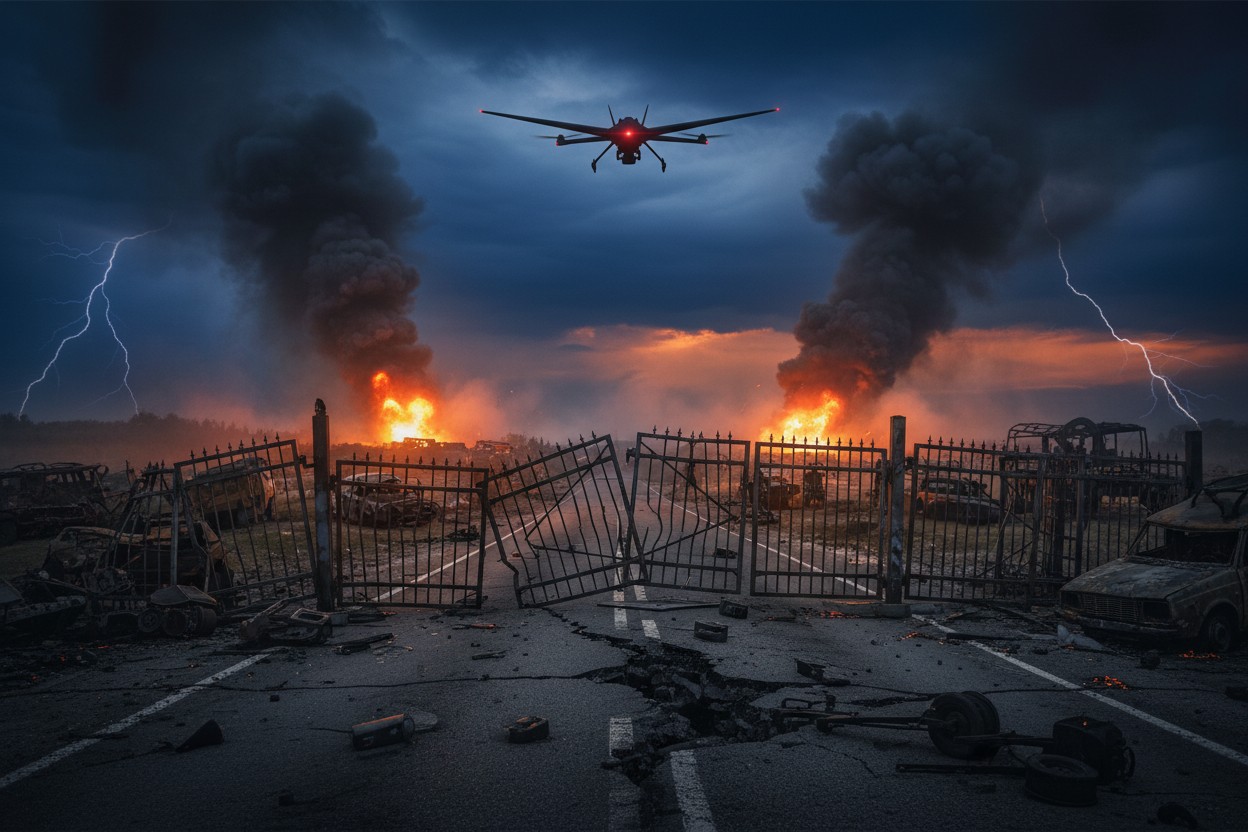
The most feared new weapon in Russia’s arsenal runs primarily on chips and compute provided by American companies. A supply-chain investigation by the Ukrainian defense outlet Militarnyi cataloged 105 electronic parts inside a downed Geran-4 jet drone and traced 80 of them, or 76.19 percent, to US companies. The finding exposes a hard truth about the 300 mph killer now streaking toward Ukrainian cities: Moscow’s newest drone leans on American silicon to think, steer and communicate, and the sanctions meant to starve Russia’s war machine have been circumvented in the most ironic way imaginable.
Key points:
- Militarnyi identified 80 US-made parts among 105 cataloged components, or 76.19 percent.
- Texas Instruments and National Semiconductor account for 61 parts, or 58.1 percent.
- At 3,000 drones per month, Russia needs more than two million of those chips each year.
- How and when the chips reached Russia remains unclear.
- A Chinese mesh modem extends the drone’s reach, and a 16-channel antenna fights jamming.
A drone with an American brain
The Geran-4 is the jet-powered successor to the Geran-2, Russia’s version of the Iranian Shahed design that Moscow began hurling at Ukraine in 2022. The upgrade matters. Where the older piston-driven model droned along far slower, the new turbojet flies about 300 mph, climbs higher and slips past conventional air defenses. Radio Free Europe/Radio Liberty, a US government-funded news organization, tore down a mostly intact example and found Texas Instruments chips at its core. The markings had been scraped off, yet the logos remained readable, a clumsy attempt to erase a fingerprint.
Militarnyi’s investigation went further. An engineering unit with Ukraine’s 1230th Athena Engineering and Technical Regiment examined chips recovered from recent wreckage, where most internal components survived intact. Markings and serial numbers let analysts name the manufacturers. Countries were assigned by the parent company’s place of registration, so Intersil parts count as products of Japan’s Renesas, while Zetex parts count as products of the American firm Diodes Incorporated.
Texas Instruments towers over the list. Together with National Semiconductor, which it acquired in 2011, the company accounts for 61 components, or 58.1 percent. Among them are TMS320F28335PGFA processors that handle data processing and control of onboard systems, VP230 CAN transceivers that let modules exchange data, MB3238I multichannel transmitters, and PS767D301 voltage regulators. REF3020 reference voltage sources supply the stable voltage that measurement circuits demand. In plain terms, American parts form the drone’s cerebral cortex, its nervous system and its heartbeat.
Other pieces come from farther east. The teardown found many foreign-made components, much of which came from China, including a Chinese mesh modem that delivers radio and live video to about 300 kilometers and can pass the link from one Geran to the next. Operators can sit in Bryansk, Oryol or Crimea and steer the drone all the way in if the mesh holds. Two GSM modems with SIM cards ping location over cellular networks, and SIMs from Ukraine, Russia, Belarus, Kazakhstan and some European Union carriers have turned up on these drones. A 16-channel CRPA antenna works to blunt Ukrainian jamming.
Sanctions on paper, silicon in practice
The numbers should unsettle policymakers. At a production rate of 3,000 units per month, Militarnyi calculates, the drone line needs more than two million Texas Instruments and National Semiconductor components each year. The outlet concluded that the figures point to “a lack of an effective mechanism for monitoring compliance with sanctions,” whether at the level of the companies themselves or at the level of government.
History offers little comfort. Since Russia’s full-scale invasion in February 2022, Washington and its allies have layered export controls on advanced electronics, yet Western-made chips keep surfacing in the wreckage of Russian weapons. The pattern is familiar to Ukrainian investigators, and it reflects the nature of the product. Microchips are tiny, plentiful and sold through long distributor chains, which makes them the water of modern warfare: they find every crack.
Nobody yet knows how or when the chips arrived. They could have come from stockpiles bought before sanctions, from later purchases routed through third-country intermediaries or shell companies, or from a mix of the two. The reporting offers no evidence that Texas Instruments or any other American firm knowingly sold to Russia, and that distinction matters. But the 19 other American components deserve the same scrutiny as the 61 traced to Texas Instruments and National Semiconductor.
Russia’s reliance on foreign parts cuts two ways. It reveals a vulnerability the West could exploit, and it indicts an enforcement system that cannot follow a chip from factory floor to circuit board. Sanctions that exist only on paper do not slow a production line running at 3,000 drones a month. Until that changes, every Geran-4 that falls on a Ukrainian city will carry in its circuitry a question Washington has yet to answer.
Sources include:
Submit a correction >>
Tagged Under:
big government, computing, Diodes Incorporated, drone warfare, export controls, future tech, Geran-4, information technology, inventions, jet drone, military technology, national security, National Semiconductor, real investigations, Renesas, RFE/RL, Russia, sanctions, semiconductors, Shahed drones, supply chain, Texas Instruments, Ukraine war, weapons technology
This article may contain statements that reflect the opinion of the author
RECENT NEWS & ARTICLES