Alphabet Shares Fall 13% After Earnings Miss; Search Revenue Growth Slows to 12%
11/01/2026 / By Chase Codewell

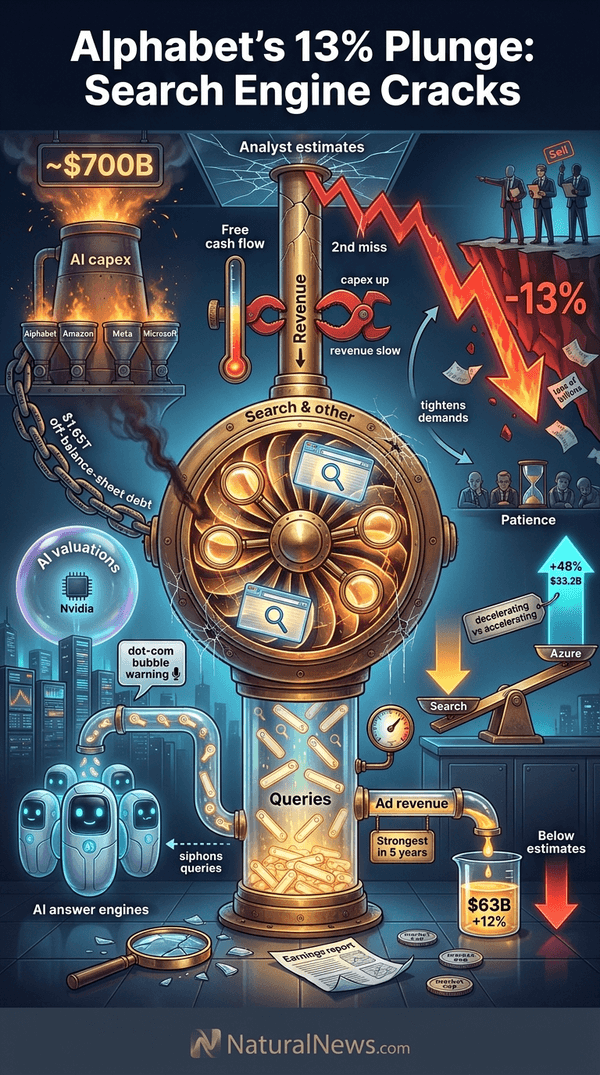
Shares of Alphabet fell by 13% following the Google parent company’s earnings miss, according to a report by CNBC on Oct. 29 [1].
The decline followed an earnings report in which revenue in the company’s search and other segments grew 12% from a year earlier to roughly $63 billion, coming in below analyst estimates for the second consecutive quarter [1]. Google said search query growth on its platform was the strongest it had been in five years, a disclosure that drew attention to the widening gap between how often people use the service and how much revenue it generates [1].
CNBC reported that Wall Street hammered Alphabet for an earnings miss that included weaker-than-expected revenue out of the company’s core business [2]. The results also revived debate over whether artificial intelligence (AI) is beginning to erode Google’s core advertising business, according to CNBC [2]. Business Insider reported that the big lingering question following the third-quarter earnings was whether AI is starting to hurt Google’s core search business [3].
Search Growth Decelerates for Third Straight Quarter as Analysts Cite AI Cannibalization
Shares in Google’s parent fell more than 10% in after-hours trading as disappointing earnings and slower search growth overshadowed its cloud business [4]. The deceleration follows prior warnings about inflated AI stock valuations and shifting market sentiment.
Google CEO Sundar Pichai warned that no company is immune to the risks of a potential market correction, comparing the environment to the dot-com bubble [5]. Separate reporting by NaturalNews describes a market in which AI stocks led by Nvidia experienced a speculative surge reminiscent of the dot-com bubble [6].
Company Points to Gemini Rollout as Advertisers Increase AI Tool Use
The company’s messaging on AI investment has coincided with mounting concern about the scale of spending across the technology sector. The five biggest cloud and AI infrastructure providers in the U.S. – Alphabet, Amazon, Meta, Microsoft and Oracle – have committed to spending almost $700 billion combined on AI capital expenditures this year, Futurum reported [7].
Cloud Revenue More Than Doubles to Nearly $31 Billion as Backlog Reaches $560 Billion
The cloud figures arrived alongside Microsoft’s disclosure that Azure revenue rose 48% to $33.2 billion for the July–September quarter, a disclosure that lets investors compare Azure’s performance more directly against Google Cloud [8]. Broader scrutiny of AI spending has also focused on financing: Alphabet, Microsoft, Amazon, Meta, and Oracle collectively carry $1.65 trillion in off-balance-sheet debt tied to AI infrastructure, according to a Nikkei study cited by The Next Web [9]. Market commentary has likewise questioned whether the returns on the AI build-out will justify the sums committed [10].
Analysts Caution Against Conclusions From a Single Quarter
“Investors will now worry that the miss in Search, YouTube and Subscription, leading to a profit miss, are an indication that AI has finally come for Google,” said D.A. Davidson analyst Gil Luria in an email.
The caution came as the broader market weighed competing signals. Microsoft’s Azure beat and lighter capital expenditure guidance offset some of the concern generated by Alphabet’s search miss, according to market coverage [11].
Longstanding concerns about Google’s concentration of power and its handling of competition and speech have accompanied the company’s expansion across search, advertising, and video. Critics of centralized control over information have also pointed to the risks of a small number of corporations dominating access to knowledge and advertising markets [12].
References
- Alphabet earnings miss reflects first real sign that AI is taking a. https://longbridge.com/en/news/303552739
- Alphabet earnings miss first sign AI is taking a bite out of. https://www.cnbc.com/2026/10/29/alphabet-google-search-ai-earnings.html
- Google Earnings: Search Revenue Miss Is a Big Red Flag – Business Insider. https://www.businessinsider.com/google-q3-2026-earnings-ai-advancements-search-revenue-lags-2026-10
- Alphabet shares plunge over 10% as Google’s AI search … – TechSpot. https://www.techspot.com/news/114381-alphabet-shares-plunge-over-10-google-ai-search.html
- Markets tumble amid tech selloff AI bubble fears intensify as Google CEO warns no company is immune – NaturalNews.com, November 20, 2025.
- AI stock melt up sparks fears of 2025 bubble burst – NaturalNews.com, October 17, 2025.
- AI Insiders Warn of Hyperscaling Risks. https://theepochtimes.com/article/ai-insiders-warn-of-hyperscaling-risks-6051198
- Microsoft just shared Azure’s actual revenue in dollars: $33.2 billion. https://techcrunch.com/2026/10/28/microsoft-just-shared-azures-actual-revenue-in-dollars-33-2-billion/
- Big Tech’s $1.65 Trillion in Off Balance Sheet AI Debt: A Closer Look at the Hidden Leverage – NaturalNews.com, July 27, 2026.
- AI CapEx And Earnings: What Happens When Growth Slows. https://www.zerohedge.com/markets/ai-capex-and-earnings-what-happens-when-growth-slows
- Tech Futures Tumble As Alphabet Plunges, Small Caps Rise Ahead Of PCE, ECB. https://www.zerohedge.com/markets/tech-futures-tumble-alphabet-plunges-small-caps-rise-ahead-pce-ecb
- Vice admits Big Tech is a great threat to journalism – NaturalNews.com, May 19, 2020.
Explainer Infographic
Submit a correction >>
Tagged Under:
Advertising, AI search, Alphabet, artificial intelligence, Big Tech, bubble, computing, debt bomb, debt collapse, earnings miss, evil Google, future tech, Glitch, information technology, investing, market crash, risk, robots, search engine, stocks, Sundar Pichai, tech giants
This article may contain statements that reflect the opinion of the author
RECENT NEWS & ARTICLES